|
The
Rogi Kalyan Samiti is an initiative which has it’s seed in the
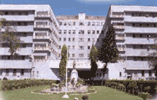
Kayakalp Abhiyan. The Kayakalp Abhiyan was a participatory drive
to clean up the Maharaja Yashwantrao Hospital in Indore, which
was infamous for its appallingly low standards of maintenance,
and its delivery of services.
|
|
The District Administration of
Indore took up this issue and involved citizens of the city,
with the medical administration of the Hospital to clean up the
hospital and streamline its systems. The results of this drive
were quite astonishing and the hospital underwent a
transformation in terms of cleanliness and hospital management.
The Kayakalp Abhiyan led to the formation of the concept of Rogi
Kalyan Samitis for this hospital in order to sustain these
efforts .
|
|
|
|
|
|
The
concept of the Rogi Kalyan Samiti was a response to the fact
that most government hospitals don’t and/or are unable to pay
enough attention to general administration and co-ordination. A
committee to act as a group of trustees for the hospital as well
as another executive committee to manage the day to day running
of the hospital were conceptualised and established. The former
group was called the Rogi Kalyan Samiti or the Patient Welfare
Committee, which was registered as an NGO and given complete
control over the functioning of the hospitals. It was also meant
to deliberate on changes and improvements that could be effected
on a continuous basis. While the Rogi Kalyan Samiti had overall
control over the assets and finances available with it, the
executive committee was to fulfil the objectives by using the
finances made available to it by the Rogi Kalyan Samiti. A
system of user charges was introduced, where such charges that
could be afforded by general patients was charged and this fund
was under the control of the Rogi kalyan Samiti for use of
maintenance of machines, hospital infrastructure and general
cleanliness.
|
|
|
|
The
objectives with which the Rogi Kalyan Samitis were established
were:
|
| |
|
|
| · |
To
carry out scientific reallocation of available space
|
| |
|
| · |
Introduce
user charges in hospitals
|
| |
|
| · |
Initiate
redefinition of administrative responsibilities. |
| |
| The
Government of Madhya Pradesh took up the example of Indore and
decided that Rogi kalyan samitis shall be fromed all over the
state. It was decided that the Rogi Kalyan Samiti’s would be
registered societies, which would exist
in all medical colleges, district
hospitals and Community Health Centres. Their members
would include people’s representatives, health officials,
local district officials, leading members of the community,
representatives of the IMA, members of the urban local bodies
and Panchayat Raj representatives as well as leading donors as
their members. RKS would be deemed not as government agencies
but almost as NGOs. |
|

|
They could utilise government assets and
services to impose user charges which they would be free to
determine on the basis of local circumstances. They could also
raise funds additionally through donations, loans from financial
institutions, grants from government and other donor agencies as
well as constructing and leasing shops on available hospital
land, taking over and managing canteens, dharamshalas, stands,
ambulance services and other facilities within the hospital
complex. |
|
|
|
|
These
funds are not deposited
in the state exchequer but are available to the executive
committees, which are constituted by the Rogi Kalyan Samiti’s.
These funds are used for maintenance and expansion of physical
facilities, arranging for private agencies for cleaning,
security, and other services, making arrangements to provide for
improved medical facilities by purchasing necessary equipment,
chemicals, furniture as well as developing appropriate methods
for disposal of medical waste. Arrangements are also made to
provide better facilities for attendants. These funds are
utilised with the objective of providing the poor and needy
medical care either at subsidised rates or free of cThe Rogi
Kalyan Samiti’s have, till date, been set up in all the districts in the state with registration at all
the three levels having been completed in some districts and the
process having started in others. Some enterprising officers
have even started the process in sub district level hospitals.
Most districts have introduced user charges. At the end of five
years from when Rogi kalyan Samitis were encouraged in every
hospital, nearly eighteen and a half crores of rupees have been
collected by the districts. Various Members of Parliament and
Members of the Legislative Assembly have
earmarked funds out of their discretionary local area
development funds as well. District Red Cross Societies have
become more active as a result of their partnership with the
Rogi Kalyan Samiti’s. The result of collecting user charges
has been the privatisation of ancillary services and initial
improvements including improvements in buildings and sanitation,
upgrading of equipment and introduction of facilities such as
burn units, ICCU, OT’s, MRI’s, etc. Pressure on staff has
been reduced as a result of privatisation and this has in turn
improved efficiency. The fact that they have been deemed NGOs
has ensured that funds are available and not constrained by
Government regulations. This results in funds being available on
a day to day basis for contingent expenditures which ensures
smoother functioning for the staff. |
| |
| The
concept of User charges also establishes the patient’s right
to better professional medical attention by putting the patient
in a position to demand better services. The doctors and
paramedical staff also feel a sense of responsibility and moral
pressure to deliver better services.
|
| |

|
|